By Michael Brosnan
After reading A.O. Scott’s recent tribute to artist, novelist, and critic John Berger, I felt a need to read, or reread, some of Berger’s writings. I had read Berger’s Ways of Seeing back in the 1980s, though I couldn’t remember much beyond the vague sense that I liked both his perspective and how he writes.
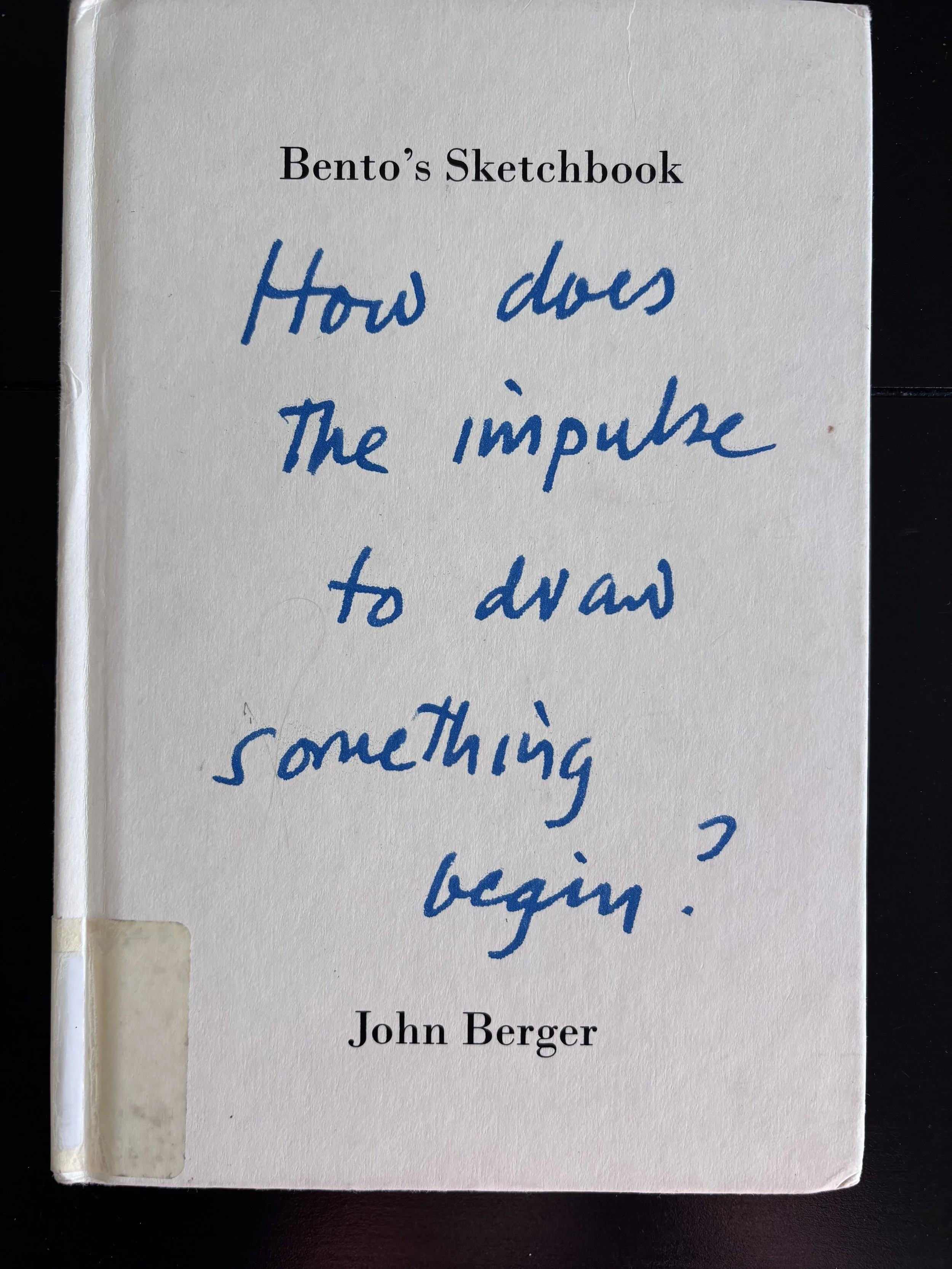
So I went in search of one of his books. Nothing on my bookshelf. Nothing in the local town library. Nothing in the local bookstores — even in the bookshop that carries a large collection of books on art. So I drove over to the nearby university library, where the only Berger book I could borrow was his 2011 collection of short, interconnected essays, Bento’s Sketchbook, with the engaging hand-drawn subtitle, How does the impulse to draw something begin? It’s a question I’ve never considered, but now that it was presented to me in the stacks of a university library, I was intrigued. So I borrowed the book.
There’s much to recommend in Bento’s Sketchbook, of course. A.O. Scott is right in praising Berger’s writing. There’s something compelling about the way he sees the world, especially the way he looks so thoroughly and thoughtfully at people and objects, at art and literature, at culture and the shape of our social interactions, and at the flow of the natural world.
The “Bento” in the title is the 17th century philosopher, Baruch Spinoza, who went by the nickname Bento. Spinoza, Berger reminds us, earned his living as a lens-grinder, but he also spent time writing two important philosophical works, On the Improvement of the Understanding and Ethics. While Berger is interested in these writings, he is also intrigued to learn that Spinoza carried around a sketchbook and in his travels made detailed drawings of objects and people. Because the sketchbook was lost over time, Berger finds himself imagining the drawings — and, later, after a publisher gives him a new sketchbook, Berger dubs it “Bento’s Sketchbook” and begins making drawings of things that catch his eye and that related to elements of Spinoza’s philosophy. The book contains Berger’s writing and sketches alongside related passages from Spinoza.
While I encourage you to read Bento’s Sketchbook, I mostly want to comment here on Berger’s sudden turn midbook to the question of tyranny. It comes as a surprise (to me, at least), given that much of the book focuses on smaller, more private moments in art — the telling facial expressions, the opening of flowers, a favorite bicycle, the depth of living captured in certain portraits, etc. Berger turns to the question of tyranny as a prelude to his commentary on artists and writers who have experienced tyranny and create works that counter it. I was particularly struck by Berger’s clarity about what tyranny is.
In the essay, Berger first notes “that the human capacity for cruelty is limitless.” Then he reconsiders, declaring that it’s more that “human indifference to cruelty is limitless.” In his revision, Berger makes it clear that what matters most is how we, individually and collectively, respond to tyrants. History implies that we are not very good at it — or have not been so to date. Most of us, in fact, are better at offering reasons — logical reasons, we tell ourselves — for turning away from the suffering of others under the cloud of tyranny. In our social media era, regardless of what we might believe, we can also easily lose focus and forget the suffering of others. The flashiness of the internet encourages us to slip into the kind of endless, wasteful scrolling that makes Meta execs happy.
Berger does not turn away, however. In Bento’s Sketchbook, he describes the tyranny that is fueled by and that fuels cruelty. “Its workings may vary according to each continent and its modes are modified by local history,” he writes, “but its overall pattern is the same, a circular pattern.”
Here’s the pattern:
“The division between the poor and the relatively rich becomes an abyss. Traditional restrains and recommendations are shattered. Consumerism consumes all questioning. The past becomes obsolete. Consequently people lose their selfhood, their sense of identity, and they locate and find an enemy in order to define themselves. The enemy — whatever their ethnic and religious nomination — is always found amongst the poor. This is where the circular pattern is vicious.
The system economically produces, alongside wealth, more and more poverty, more and more homeless families, while simultaneously it politically promotes ideologies which articulate and justify the exclusion and eventual elimination of the hordes of new poor.”
Berger concludes: “It is this new political-economic circle which today encourages the constant human capacity for cruelties that obliterate the human imagination.”
Berger, who died in 2017, is, of course, encouraging and supporting artists and writers who bear witness to the effects of tyranny (see also Carolyn Forché’s Poetry of Witness). But what matters equally is that we read these writers and study these artists so that we see tyranny more clearly — and through our own actions help break the cycle.
It’s not just about reading or viewing art and coming to a personal understanding of tyranny. It’s about voting and helping to get out the vote. It’s about protesting in the name of justice. In the U.S. it’s about standing up for the aspirations and ideals presented in our founding documents. It’s about us coming to a far better understanding of the troubling relationship between democracy and capitalism. It’s about coming to a far clearer picture of the immigrant experience and the real impact of immigration on our nation. It’s about encouraging religious institutions to embrace their own moral reasoning — counter hatred and intolerance and division. It’s about resisting the impulse for war and improving diplomacy. It’s about understanding climate change and taking steps to stop and reverse the damage and suffering it causes.
I suppose, for Berger, all of this is related to the art of looking. To ways of seeing. (I agree — thus the name of this Substack page: Between the Eye and the Hand.) What we see, what we learn through our senses, feeds how we think and act. And it seems to me we’re at a critical juncture. We can either shrug off the circular systems that feed the current strains of tyranny or we can respond as caring, thoughtful, moral people do.
Berger is quite articulate on the subject. More so than I am. So I’ll leave you with his quote from a conversation he had with writer Arundhati Roy, who witnessed the widespread massacre of Muslims by Hindus in India in the spring of 2002.
“The question here, really, is what have we done to democracy? What have we turned it into?” Roy says. “What happens… when it has been hollowed out and emptied of meaning?”